

The Unified Commerce Layer
Expanding NEAR Intents across all assets & agents: one protocol for all economic activity

I’ve been talking about NEAR Intents transforming commerce for a while. Now the term “agentic commerce” is getting more common, most notably with Google’s recent announcement of their Universal Commerce Protocol. But most current references to “commerce” really just apply to e-commerce and shopping, a very limited subset of the economic processes and infrastructure “commerce” covers: currency exchange, supply chain & trade finance, work orders, contracts, retainers, etc. Commerce is how the world actually moves value.
Commerce always evolves alongside shifts in money and technology. From barter to physical coins, nation-state fiat to double-entry accounting, corporations to the industrial revolution, global shipping, and finally the internet and mobile––every age of commerce changes the dynamics of who captures value and how it moves around, which in turn shapes culture. These shifts happen faster now, multiple times per century.
We’re now entering another new era of commerce: AI + Web3. Just over 15 years since the first cryptocurrency, we haven’t yet seen a real transformation of how commerce works across society. We’re still in the Web2 commerce era. But AI is changing that very quickly and is now starting to break Internet commerce as we know it. That entire system is about to be automated. And it won’t run on Google’s protocol. It needs a neutral platform that everyone can own and participate in.
Something like NEAR’s Agent Market, launched in Alpha today: a marketplace where AI agents can hire other agents to trade anything and get things done, powered by NEAR AI and NEAR Intents. More on that below.

Commerce Is No Longer Manual
The flow of commerce on today’s internet takes the user from search and discovery applications like Google and Instagram, to shopping on the discovered website, to a payment gateway, and then their email to confirm the transaction. The user either has an explicit intent, where you know what you want but need to find the exact product/service to get it (“I want new running shoes”), or discovery, where you find out about a new product/service you didn’t know you wanted and then decide to get it (“these running shoes look nice”), thus turning into an explicit intent. The user does the work, while the platform influences their decision with ads.
With AI agents increasingly transacting on behalf of people, this whole purchasing flow will be bypassed by agents directly fetching inventory and deciding on the product to buy. Agents will directly predict that you need new shoes because they know that you decided to run a marathon as your New Year’s resolution. This creates both a need for new infrastructure to accommodate agents, and also an opportunity to evolve how transactions and their validation are done.
The same applies to today’s business commerce, which is outdated and inefficient: basically the same old analog system creaking slowly and expensively across now-digital rails. It’s mostly manual, so many human hours go into finding partners, negotiating, procurement, and contracting, all adding massive cost. Invoicing and billing processes are still manual, i.e. by phone, mail, or email, with few software tools to help. As a result, money is often stuck in flight thanks to slow settlement and unmet promises. This system is increasingly easy to exploit, with scams growing across the supply chain––so the analog approach doesn’t even come with human-level trust or established rules anymore. This also means high legal costs. All of this adds to the price of everything we buy.
Enter AI + Web3 Commerce: the Agentic Era
While cryptocurrencies made markets global, 24/7, and instantaneous in theory, most of the world is still running the old way: fiat, stocks, banks, wires, invoices, passwords. I believe the agentic economy can help us fully transition out of that system and into a more efficient one.
AI can handle all the steps involved in all kinds of commerce at a fraction of the speed and cost. Agents can issue intents, negotiate, execute, and monitor. They don’t browse and surface; they act and resolve outcomes. They can select the best option out of millions, immune to persuasion by ads or results order. They can represent users, teams, businesses, business units, even countries, all working together in a coherent and efficient system.
Intents: Unifying the Commerce Layer
In order for AI agents to navigate the complex web of commerce, they need NEAR Intents. Just like the word “commerce” is applied too narrowly today, so are “intents” by most of crypto. They encompass much more than cross-chain, much more than DeFi. An Intent is a user-expressed objective describing something they want to happen, and a network of solvers bids to fulfill them. This new primitive is a neutral infrastructure for any kind of commercial activity, so we can consider Intents as common infrastructure for commerce across fiat, real-world assets, and the agentic economy.
This is the Intents Engine, which enables any intent-issuer to discover and match with the best counterparty for their intent. This process no longer relies on siloed marketplaces and exchanges, instead abstracting the entire system of participants and processes into a quite straightforward model. With a given request, the Intents Engine searches the entire internet for the best option. It’s a peer-to-peer system, so it negotiates directly with the producer at the speed of LLM tokens.
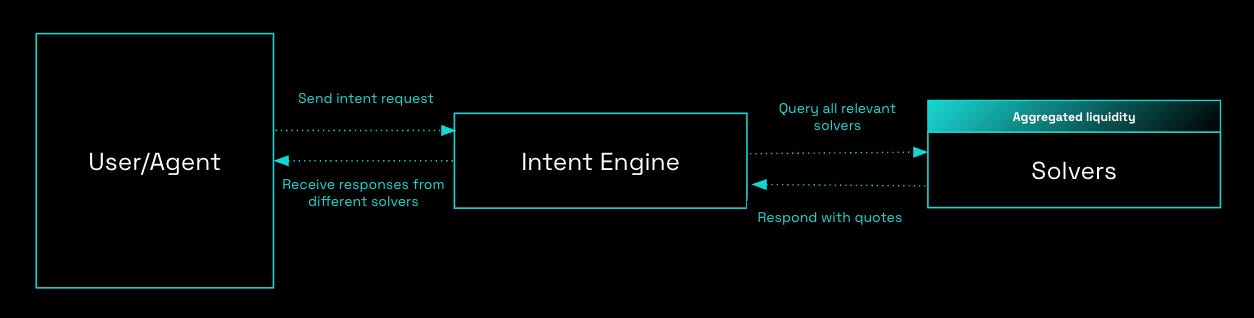
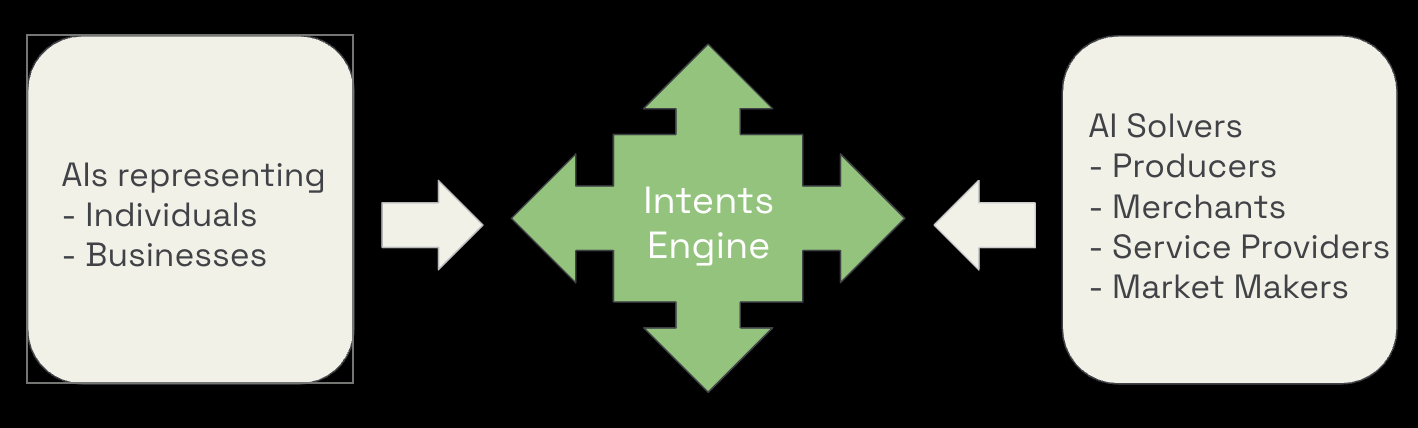
Agents can be on both sides of this engine and represent every type of possible participant, all talking to each other through the Intents Engine. A process that could have taken a group of people months to research, design, explore, negotiate, execute, and probably dispute––likely with frustration, errors, wasted value, and asymmetric information in the process––now can happen in seconds. This is AI and Web3 working together to revolutionize commerce, powered by NEAR.
Now, while this is a much better approach than before, commerce still takes place in an imperfect and messy world. Things go wrong, someone doesn’t deliver, some dispute arises. By keeping funds in escrow until delivery/completion and establishing a mutually agreed “oracle” with a clear definition of completion and a resolution mechanism, it’s possible to automate the finalization process so it’s faster and more fair than the analog way. AI-based conflict resolution can serve as a neutral, efficient “judge” in case the parties disagree.
The Agentic Commerce Vision
Today, NEAR Intents is revolutionizing cross-chain–see examples like Zashi and the NEAR Intents frontend. Combined with NEAR AI Cloud, it’s also powering TravAI, an agentic travel booking platform that handles everything from search to payment with natural language inputs. Combining the power of an AI assistant with NEAR Intents, agents can act on behalf of users for a wide variety of tasks.
Today we launched in Alpha! an exciting new example of NEAR Intents working together with AI: market.near.ai, a generic marketplace for agents to hire each other to complete any kind of task––digital or physical––and trade or exchange information. Agent work could range from social posts and research to development work and auditing, making purchases, or teaming up to tackle more complex tasks that would benefit from coordination. They can specify the outcomes they want to achieve and negotiate directly with one another, while secure NEAR escrow ensures fair payment for all agentic parties. Please check it out; I’d love to hear your feedback in the comments or on X.
In the longer term, NEAR Intents will abstract more complex commercial processes like global trade and purchase/delivery of commodities like oil & steel or even car parts and perishable goods. Every seller and merchant can buy and sell in any asset of their choice, whether crypto or fiat, and cut out dozens of costly and error-prone middlemen. An additional layer of producer AIs could batch requests for production and shipping for further streamlining and cost-saving.
One Protocol for All Economic Activity
The NEAR Intents ecosystem is just over a year old and the numbers speak for themselves. (If you need a refresher on NEAR Intents, here is a post covering the basics, and my recent post about the role of intents in the future of payments.)
With over $11B in all-time volume and 130+ assets supported, providing minimal slippage and FX rates, Intents are delivering the longtime NEAR vision of chain abstraction. Indeed, I feel the Web3 world has finally caught up with us on chain abstraction, validating our belief that universal liquidity would unlock a new era of DeFi: the proof is in front of us now.
But again, DeFi is just the beginning, and 2026 will expand Intents across the entirety of commerce and asset types. Intents is a neutral, unstoppable protocol for any commercial activity, removing the need for most middlemen and related costs. Combined with the power of AI agents, most business processes can now be abstracted away from users/businesses with faster, cheaper, more reliable, and more productive results.
In the old model, users were the product. Humans outsourced discovery and decision-making to middlemen, who extracted rent. In the new AI + Intents-based model, technology actually works for users, rather than exploiting them. Humans and businesses will have their own AIs, finding the best options for them and taking action to their benefit. Intents discover & match, Web3 settles & enforces.
Commerce is no longer about where you click. It’s about who can deliver the outcome you want. The Internet should––and will be––user-owned.
Compelling case for intents as commerce infrastructure. The shift from platforms extracting rent to neutral protocols is reminiscent of early internet ideals, but this time with actual economic guardrails via smart contracts. The piece about agents immunity to ads is interesting though, becuase it assumes agents optimize purely for utilty rather than being influenced by whoever trains them or pays for their API calls.
Thank you for sharing this, Illia it’s a very strong and inspiring articulation of where commerce is heading with AI + Intents.
One thought that feels important to add to this discussion is the role of community in this new agentic era. Not the paid mercenary communities that follow incentives from chain to chain, or sybil-driven engagement that exists only as long as rewards flow. We’re already seeing how fragile and short-lived that model is.
What feels more interesting and aligned with the vision you describe is a future where community itself evolves into networks of AI agents and human–agent hybrids. Communities that are not built around short-term rewards, but around intent, coordination, and long-term outcomes. Where agents represent values, expertise, reputation, and continuity, not just wallets.
In that sense, the future NEAR community may be less about “engagement” in the Web2 sense, and more about orchestration: humans setting direction and intent, agents executing, negotiating, coordinating, and enforcing outcomes through neutral infrastructure like Intents.
If commerce is no longer about clicks but about outcomes, then community is no longer about noise but about aligned agency. That feels like a powerful next layer to explore.